
Her Letter
Dear Lauren,
I thought for quite a long time about what I could give to each of my grandchildren when they graduated from college. What I decided upon is this folder of articles. I have copied parts from books that I have read that were written by some very wise teachers and philosophers. They are not at all my words, but thoughts that I want always to remember.
I would have loved to have known many of these things when I was younger, that is why I wanted to pass them along to you as you are starting out on your adult life.
Walden is my favorite book of all time. Thoreau is so wise that whatever he writes is something you want to ponder. Our culture makes us think that we always need more of everything while Thoreau tells us that the simpler we keep our lives, the happier we will be.
It is so easy to fall into the trap of blaming others when things go wrong, or becoming offended by a comment someone makes. The Power of Intention, The Four Agreements, and The Seven Spiritual Laws of Success give you a different perspective on how to handle those occasions.
Although Buddhism is different than our Catholic religion, I thought it was very interesting how the Eightfold Path lays out a plan for life that is so similar to what Jesus taught. It reinforces in our mind the values that lead to a fulfilling life. And Plato tells us what is needed to be a just man.
The book on the new physics had so many interesting facts in it that I wanted to share them with you. It ties in with the other books in the fact that when things are reduced to their most elementary state, what we have left is energy.
The articles included are just glimpses of what these books have to offer. If you want more information, you may borrow my books any time you want.
I hope that you will find a job that you will love. I'm very proud of you and I know you will do wonderful things in your life.
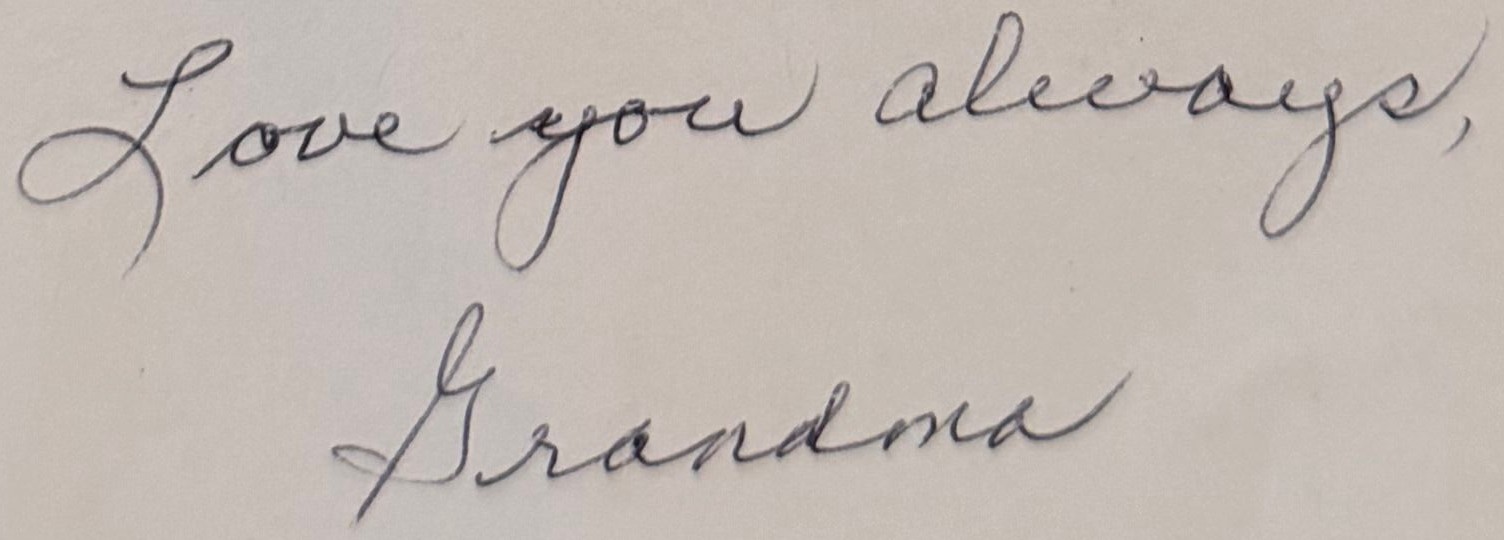
Take good care of yourself
What's inside the folder
Seven passages, in the order she arranged them.
Her Family
The ones she gathered this for
Eileen made this folder for her grandchildren — and it carries on to her great-grandchildren, the family that grew from the same roots.
2 children · 5 grandchildren · 13 great-grandchildren
His children
Her children
Chapter I
Buddhism
Buddha means the “Enlightened One” or the “Awakened One”.
The man who was called the Buddha was Siddhartha Gautama of the Sakyas. He was born around 563 B.C. in Nepal near the Indian border. His father was a king.
Gautama was a handsome and wealthy man and had a model wife and a beautiful son. He became very discontented in his early twenties and for six years his energies were concentrated toward his search for enlightenment.
First, he sought out two Hindu masters to pick their minds for the wisdom in their vast tradition.
Second, he joined a band of ascetics to try their way. He found this unsuccessful, but it provided him with the first constructive plank for his program. He discovered the principle of the Middle Way — a way of life between the extremes of asceticism and indulgence. It is the concept of the rationed life, in which the body is given what it needs to function optimally, but no more.
Third, he came to a combination of rigorous thought and mystic concentration, after which the Great Awakening arrived. Gautama's being was transformed, and he emerged the Buddha.
He founded an order of monks and maintained a heavy schedule of public preaching and private counseling. He had a cool head and a warm heart and was gifted with preternatural insight into character. No matter where an individual stood in society, the Buddha showed him a respect that stemmed from the simple fact that he was a fellow human being. There was an amazing simplicity about him. He spent the next forty-five years preaching and teaching. His message was one of infinite compassion.
The Buddha was one of the greatest personalities of all time. He died around 483 B.C. at the age of eighty.
Buddhism grew out of Hinduism. It appeared overnight, fully formed. In a large measure it was a religion of reaction against Hinduism. There are six aspects of religion that surface so regularly as to suggest that their seeds are in the human make-up. All six had been exploited by the Hinduism of the Buddha's day and were corrupting the religion. After his death all the accoutrements that the Buddha labored to protect his religion from came tumbling in, but as long as he lived he kept them away.
The contrasts between most religions and Buddhism
- Authority — devoid of authority; to do his own religious seeking
- Ritual — devoid of ritual
- Speculation — skirted speculation
- Tradition — devoid of tradition
- Grace — preaches intense self-effort
- Mystery — devoid of the supernatural
Original Buddhism can be characterized in these terms
- It was empirical — personal experience was the final test of truth.
- It was scientific — there is no effect without its cause.
- It was pragmatic — concerned with problem solving.
- It was therapeutic — teaches about suffering and the end of suffering.
- It was psychological — begins with the human lot, its problems, and coping with them.
- It was egalitarian — men and women and all classes were equal.
- It was directed to individuals — each should proceed toward enlightenment through confronting his own individual situation.
The Four Noble Truths
The Buddha's first formal talk after his awakening concerned the Four Noble Truths. They constituted the foundation of his philosophy and the base from which the rest of his teachings followed. These were the key discoveries that had come to him at the end of his six-year journey.
The First Noble Truth — the declaration
Life is suffering. Something has gone wrong. It is out of joint. Friction (interpersonal conflict) is excessive. Movement (creativity) is blocked. It hurts.
The Buddha pinpointed six moments when life's suffering becomes glaringly apparent:
- The trauma of birth.
- The pathology of sickness.
- The morbidity of decrepitude — with all the fears associated with growing old.
- The phobia of death.
- To be tied to what one dislikes.
- To be separated from what one loves.
The First Noble Truth pulls them together by concluding that the five skandas (life components) are painful. As these skandas are body, sensations, thoughts, feelings and consciousness — the whole of human life (as usually lived) is suffering.
The Eightfold Path
- Life needs some blueprint if we are to direct our energies purposively.
- Life needs some intellectual orientation.
- Advises us to make up our hearts as to what we really want.
- Is it really enlightenment? Persistence is indispensable.
We must become aware of our speech and what it reveals about our character. We must resolve to notice how many times during the day we deviate from the truth and ask ourselves why we did so. We must ask how many times were we uncharitable in our speech. We must become aware of the motives that prompt unkindness. Then, we will be ready to try some changes.
toward veracity — The Buddha considered deceit more foolish than evil because it reduces one's being. The motive is almost always fear of revealing what we really are.
toward charity — In obvious forms, such as tactlessness, and in covert forms, such as barbed wit.
The admonition involves a call to understand one's behavior more objectively before trying to improve it. One is to reflect on actions with an eye to the motives that prompted them. The direction to proceed is toward selflessness and charity. The directives are detailed in the Five Precepts:
- Do not kill.
- Do not steal.
- Do not lie.
- Do not be unchaste.
- Do not drink intoxicants.
- Engage in occupations that promote life instead of destroying it.
- Don't forget that earning a living is life's means, not life's end.
The Buddha laid tremendous stress on the will. Reaching a goal requires immense exertion. There are virtues to be developed, passions to be curbed, and destructive mind sets to be expunged. Then, detachment and compassion can have a chance to develop.
All we are is the result of what we have thought. All things can be mastered by mindfulness. Ignorance is the problem. Continuous self-examination will gradually overcome ignorance. If we maintain a steady attention to our thoughts and feelings, we find that they swim in and out of our awareness, and are in no way permanent parts of us. We should witness all things non-reactively, especially our moods and emotions, neither condemning some nor holding onto others.
To have the ability to integrate the insights and experiences that come into view and emerge with heightened self-knowledge and greater self-control.
Back to contentsChapter II
The Republic
The basic question in Plato's book is what does “Doing the right thing” or “Justice,” as it is called in The Republic, mean? Socrates is leading the discussion and asking the questions.
Justice is sometimes spoken of as a virtue of an individual and sometimes as a virtue of a State. With the State being larger than an individual, the quantity of justice is likely to be large and more easily discernible. Therefore, he decides to find justice first in the State.
In an ideal State you would have three classes of citizens. The Guardians, which consist of the Rulers of the State and the Auxiliaries that assist the rulers and execute their decisions. The third class are the Craftsmen, which includes all those citizens who take no part in governing or protecting the state. In this ideal State you would expect to find the four Cardinal Virtues.
The four virtues in the State
In each of us there are the same principles and habits which there are in the State, and from the individual they pass to the State. The three principle parts of the mind or soul of an individual are: (a) reason, (b) the emotional or spirited part, and (c) desire. In a good and well-educated man, reason will always be in control of the other two parts of his mind.
The three parts of the mind correspond to the three classes of the state. Reason corresponds to the rulers. The emotional or spirited part corresponds to the auxiliaries. Desire corresponds to the craftsmen class.
Socrates says we shall expect to find the four Cardinal Virtues in the individual in exactly the same way as we found them in the state.
The four virtues in the individual
Therefore, a just man is one whose mind is in good order. Justice is not simply a matter of behavior but is something internal. It is a disposition in the soul or mind of a man. If you have a well-ordered soul, then you will inevitably do the right things and perform good and just actions.Back to contents
Chapter III
Walden
Thoreau was born in 1817 in Concord, Massachusetts. After graduating from Harvard he taught school for a short time and then held various other jobs. He began his lifelong habit of journal writing. His close friend was Ralph Waldo Emerson. Thoreau built a cabin for himself on Emerson's property at Walden Pond in 1845. He attempted to find a spiritual awakening by returning to a simple life in the Massachusetts woodlands. He spent two years living there. Following are sentences taken from Walden that she wanted to remember.
What a man thinks of himself, that it is which determines, or rather indicates, his fate. The mass of men lead lives of quiet desperation. But it is characteristic of wisdom not to do desperate things.
It is never too late to give up our prejudices.
The necessaries of life for man in this (Massachusetts) climate are Food, Shelter, Clothing, and Fuel; for not till we have secured these are we prepared to entertain the problems of life with freedom and a prospect of success.
Most of the luxuries, and many of the so-called comforts of life, are not only not indispensable, but positive hindrances to the elevation of mankind. With respect to luxuries and comforts, the wisest have ever lived a more simple and meager life than the poor. The ancient philosophers were a class than which none has been poorer in outward riches, none so rich in inward.
To be a philosopher is not merely to have subtle thoughts, but so to love wisdom as to live according to its dictates, a life of simplicity, independence, magnanimity, and trust. It is to solve some of the problems of life, not only theoretically, but practically.
If one designs to construct a dwelling-house, it behooves him to exercise a little Yankee shrewdness. Consider first how slight a shelter is absolutely necessary.
In the savage state every family owns a shelter as good as the best, and sufficient for its coarser and simpler wants. It is evident that the savage owns his shelter because it costs so little, while the civilized man hires (mortgages) his because he cannot afford to own it (outright).
If it is asserted that civilization is a real advance in the condition of man, it must be shown that it has produced better dwellings without making them more costly; and the cost of a thing is the amount of what I call life which is required to be exchanged for it.
Most men appear never to have considered what a house is, and are actually though needlessly poor all their lives because they think they must have such a one as their neighbors have. It is possible to invent a house still more convenient and luxurious than we have, which yet all would admit that man could not afford to pay for. Shall we always study to obtain more of these things, and not sometimes to be content with less?
I have met an immigrant tottering under a bundle which contained his all, but because he had all that to carry. I have pitied him, not because that was his all.
I am convinced, both by faith and experience, that to maintain one's self on this earth is not a hardship but a pastime, if we will live simply and wisely.
A man is rich in proportion to the number of things which he can afford to let alone.
As long as possible live free and uncommitted (to material things). It makes but little difference whether you are committed to a farm or the county jail.
Every morning was a cheerful invitation to make my life of equal simplicity with Nature herself. The morning, which is the most memorable season of the day, is the awakening hour. Then there is least somnolence in us; and for an hour, at least, some part of us awakes which slumbers all the rest of the day and night.
All memorable events transpire in morning time and in a morning atmosphere. To him whose elastic and vigorous thought keeps pace with the sun, the day is a perpetual morning.
I know of no more encouraging fact than the unquestionable ability of man to elevate his life by a conscious endeavor. To affect the quality of the day, that is the highest of arts. Every man is tasked to make his life, even in its details, worthy of the contemplation of his most elevated and critical hour.
I went to the woods because I wished to live deliberately, to front only the essential facts of life, and see if I could not learn what it had to teach, and not, when I came to die, discover that I had not lived. I wanted to live deep and suck out all the marrow of life, to live so sturdily and Spartan-like as to put to rout all that was not life.
Simplicity, simplicity, simplicity! I say, let your affairs be as two or three, and not a hundred or a thousand.
We are for the most part more lonely when we go abroad among men than when we stay in our chambers. A man thinking or working is always alone, let him be where he will. Solitude is not measured by the miles of space that intervene between a man and his fellows.
A lake is the landscape's most beautiful and expressive feature. It is earth's eye; looking into which the beholder measures the depth of his own nature.
If the day and night are such that you greet them with joy, and life emits a fragrance like flowers and sweet-scented herbs, is more elastic, more starry, more immortal — that is your success.
Our whole life is startlingly moral. There is never an instant's truce between virtue and vice. Goodness is the only investment that never fails.
A thousand regions in your mind
Yet undiscovered. Travel them, and be
Expert in home — cosmography.
I left the woods for as good a reason as I went there. Perhaps it seemed to me that I had several more lives to live, and could not spare any more time for that one.
I learned this, at least, by my experiment: that if one advances confidently in the direction of his dreams, and endeavors to live the life which he has imagined, he will meet with a success unexpected in common hours. In proportion as he simplifies his life, the laws of the universe will appear less complex, and solitude will not be solitude, nor poverty poverty, nor weakness weakness. If you have built castles in the air, your work need not be lost; that is where they should be. Now put the foundation under them.
Let every one mind his own business, and endeavor to be what he was made.
Why should we be in such desperate haste to succeed and in such desperate enterprises? If a man does not keep pace with his companions, perhaps it is because he hears a different drummer. Let him step to the music which he hears, however measured or far away.
No face which we can give to a matter will stead us so well at last as the truth. This alone wears well.
Rather than love, than money, than fame, give me truth.
Chapter IV
The Power of Intention
Intention is a force that exists in the universe as an invisible field of energy. It is like the air we breathe, always there and available to us. All we have to do is to realign ourselves to activate intention. It cannot be accessed through our ego, but through our natural selves. The process takes place in four stages:
- Discipline — train your body to perform as your thoughts desire.
- Wisdom — combined with discipline fosters your ability to focus and be patient.
- Love — love what you do and do what you love.
- Surrender — where you can lighten up and can consult with your infinite soul. Then the power of intention becomes available to take you wherever you feel destined to go.
Say the word intent or intention repeatedly when you're in a state of anxiety or when things aren't going right. This is a reminder to be peaceful and calm.
Tell yourself that you have a life mission and a silent partner who's accessible at any moment you choose. Say to yourself, “I'm here on purpose, I can accomplish anything I desire, and I do it by being in harmony with the all-pervading creative force in the universe.”
Act as if anything you desire is already here. Treat yourself as if you already are what you would like to become.
The seven faces of intention
Intention is part of the inexplicable, nonmaterial world of Spirit which cannot be explained or defined. Wayne Dyer describes a way that he conceptualizes intention by what he calls the seven faces of intention:
- Creativity — the power of intention that designed us, got us here, and created an environment that's compatible with our needs and intends for us to be creative in anything that we direct our power of intention toward.
- Kindness — whether extended, received, or observed, beneficially impacts the physical health and feelings of everyone involved. Unkind thoughts weaken, and kind thoughts strengthen, your connection to intention.
- Love — the face of intention that wishes only for us to flourish and grow, and become all that we are capable of becoming.
- Beauty — remember that beautiful thoughts build a beautiful soul. By choosing to see beauty in everything and everyone, you will be able to experience the power of intention.
- Expansion — the power of intention is the power to expand and increase all aspects of your life.
- Unlimited abundance — this face of intention is an expression of something that has no boundaries, is everywhere at once, and is endlessly abundant.
- Receptivity — intention welcomes everyone and every living thing, without judgment. We only need to recognize it and receive it.
The way to establish a relationship with Spirit and access the power of this creating principle is to continuously contemplate yourself as being surrounded by the conditions you wish to produce. Your imagination allows you to think from the end. Imagine exactly how you want something to turn out and that the means to achieve it are accessible and waiting for you to use.
Make an effort to live in cheerful kindness to yourself and all others. It's through giving that we receive; it's through acts of kindness directed toward others that our immune systems are strengthened.
Love is the force behind the will of God. It is the very energy that is the cause behind all creation. Love is cooperation rather than competition.
Begin to see beauty in everything that you see, touch, and experience. Beauty is truth.
Be ever-expansive. When you keep growing intellectually, emotionally, and spiritually you're identifying with the universal mind and are receptive to the power of intention.
Abundance is what God's kingdom is about. When you shift to an abundance mind-set, the all-creating force to which you're always connected begins to work with you.
Be receptive. The universal mind is ready to respond to anyone who recognizes their true relationship to it. Stay connected and know you'll receive all that this power is capable of offering. The nature of the universal mind is peaceful. It isn't receptive to force or violence. It works in its own time and rhythm.
The obstacles to connecting with intention
- Thinking about what's missing in your life. Instead, think about what you absolutely intend to attract into your life.
- Thinking about the circumstances of your life. Train your imagination to shift from what you don't want to what you do want.
- Thinking about what has always been. Any thoughts that take you backward are impediments to manifesting your desires. Get rid of them.
- Thinking about what “they” want for you. Does it match what you want? If not, simply laugh at the absurdity of being upset or frustrated over the expectations of others about how you should be running your life. Become impervious to the criticisms of others.
Every thought you have has an energy that will either strengthen or weaken you. It is only discord acting within your own feelings that will ever deprive you of every good thing that life holds for you. Some of the low energy thoughts that weaken us are shame, anger, hatred, judgment, and fear. When you think, feel, and act kindly, your thoughts strengthen in energy and you give yourself the opportunity to be like the power of intention.
The self-important ego is man's greatest enemy. It is essential that we have a strong self-concept and that we feel unique. The problem is when we identify ourselves as our bodies, our achievements, and our possessions. Then we tend to identify people who have accomplished less as inferior, and our self-important superiority causes us to be constantly offended in one way or another.
Seven steps for overcoming ego's hold on us
- Stop being offended. That which offends you weakens you.
- Let go of your need to win. Ego loves to divide us up into winners and losers. You may enjoy competing in games, but you don't have to agree that the opposite of winning is losing. That's ego's fear.
- Let go of your need to be right. Ego is the source of a lot of conflict because it pushes you in the direction of making other people wrong. Ask yourself if you want to be right or do you want to be happy.
- Let go of your need to be superior. Don't think about being better than someone else, but being better than you used to be. We are all equal in the eyes of God.
- Let go of your need to have more. Ego is never satisfied. When you stop needing more, more of what you desire seems to arrive in your life. Then since you're detached from the need for it, you find it easier to pass it along to others.
- Let go of identifying yourself on the basis of your achievements. Be grateful for the abilities you've been given, the motivation to achieve, and the things you've accumulated, but remember that it all comes from God.
- Let go of your reputation. Your reputation is not located in you. It resides in the minds of others. You have no control over it at all. Connection to intention means listening to your heart and conducting yourself based on what your inner voice tells you is your purpose here.
You receive what you want for others. This is a part of all religions. As Jesus said, “Do unto others as you would have them do unto you.” When you pray for peace and happiness for all others, peace and happiness will flow to you.
Remember that you are an infinite spiritual being having a human experience and that you have a permanent connection to the abundance and energy of God.Back to contents
Chapter V
The Four Agreements
Thousands of years ago, the Toltec were known throughout southern Mexico as women and men of knowledge. They formed a society to explore and conserve the spiritual knowledge and practices of the ancient ones. Their knowledge has been passed down through the generations by its teachers. Toltec knowledge arises from the same essential unity of truth as all sacred traditions found around the world. It is not a religion, but is described as a way of life, distinguished by the ready accessibility of happiness and love.
They say that there are four very powerful agreements. These agreements will help us avoid the thoughts that create fear and deplete our energy, and empower us to create the thoughts that lead to a fulfilling and happy life.
The First Agreement — Be Impeccable With Your Word
The word is a force; it is the power you have to express and communicate, to think, and thereby to create the events in your life. Your word can create the most beautiful dream, or your word can destroy everything around you.
Speak with integrity. Say only what you mean. Avoid using the word to speak against yourself or to gossip about others. Use the power of your word in the direction of truth and love.
Impeccability means “without sin.” According to Ruiz, a sin is anything you do which goes against yourself. You go against yourself when you judge or blame yourself for anything. Being impeccable is not going against yourself. When you are impeccable, you take responsibility for your actions, but you do not judge or blame yourself. You learn from your mistakes and move on to do better the next time.
The power of the word is often completely misused. It is used to curse, to blame, to find guilt, to destroy. It is used to create chaos and hatred between different people. It is often used to gossip about someone to gain the support of others for your point of view.
Being impeccable with your word is the correct use of your energy; it means to use your energy in the direction of truth and love toward yourself and others.
The Second Agreement — Don't Take Anything Personally
Whatever happens around you, don't take it personally. Nothing others do is because of you. What others say and do is a projection of their own reality, their own dream. When you are immune to the opinions and actions of others, you won't be the victim of needless suffering.
When you take things personally, then you feel offended, and your reaction is to defend your beliefs and create conflicts. We make something big out of something little, because we have the need to be right and make everybody else wrong. Our point of view is something personal to each of us. It is no one's truth but our own.
Even when a situation seems so personal, even if others insult you directly, it has nothing to do with you. What they say, what they do, and the opinions they give are in their own minds. If someone insults you or puts you down, don't take it personally, because the truth is that this person is dealing with his own feelings, beliefs, and opinions. The same goes when people praise you. It is just their opinion they are giving you.
Wherever you go you will find people lying to you. You have to trust yourself and choose to believe or not to believe what someone says to you. They are lying to you because they are afraid you will discover that they are not perfect. If others say one thing, but do another, you are lying to yourself if you do not believe their actions. Telling yourself the truth about it may hurt, but it's just a matter of time and things will be better for you.
When you make it a strong habit not to take anything personally, you avoid many upsets in your life. Your anger, jealousy, and envy will disappear, and even your sadness will leave you.
There is a huge amount of freedom that comes to you when you take nothing personally. It helps you to break many habits and routines that trap you in bad dreams and cause needless suffering. You won't need to place your trust in what others say or do. You will only need to trust yourself to make responsible choices. You are never responsible for the actions of others; you are only responsible for you.
The Third Agreement — Don't Make Assumptions
We have the tendency to make assumptions about everything and then we believe that they are the truth. We make assumptions about what others are doing or thinking and then we blame them and react in a negative manner. We make an assumption, we misunderstand, we take it personally, and we end up creating a whole big drama for nothing.
Because we are afraid to ask for clarification, we make assumptions, and believe we are right about the assumptions; then we defend our assumptions and try to make someone else wrong. It is always better to ask questions than to make an assumption, because assumptions set us up for suffering.
Find the courage to ask questions and to express what you really want. Communicate with others as clearly as you can to avoid misunderstandings, sadness, and drama.
The Fourth Agreement — Always Do Your Best
Under any circumstance, always do your best. But your best is never going to be the same from one moment to the next. It will be different when you are healthy as opposed to sick, or when refreshed and energized in the morning than when you are tired at night.
When you always do your best, you take action. Doing your best is taking the action because you love it, and not because you're expecting a reward. Many people only work for the paycheck. They hate what they are doing and suffer putting in the time, and consequently do not do their best. They are working for the reward, and as a result they resist work.
If you take action just for the sake of doing it, without expecting a reward, you will find that you enjoy every action you take. Rewards will come, but you are not attached to the reward. You can even get more than you would have imagined for yourself without expecting a reward. If we like what we do, if we always do our best, then we are really enjoying life.
When you do your best, you have no regrets. You learn to accept yourself. If you make a mistake, you learn from it, but do not condemn yourself for it.
The first three agreements will only work if you do your best. Don't expect that you will always be able to be impeccable with your word. Your routine habits are too strong and firmly rooted in your mind. But you can do your best. Don't expect that you will never take anything personally; just do your best. Don't expect that you will never make another assumption, but you can do your best.
If you honor these four agreements, then you are going to have a beautiful life.Back to contents
Chapter VI
The Seven Spiritual Laws of Success
According to Deepak Chopra, success in life could be defined as the continued expansion of happiness and the progressive realization of worthy goals. Success is the ability to fulfill your desires with effortless ease. Success is a journey, not a destination. He lists seven laws which guide this journey.
First: The Law of Pure Potentiality
This law is based on the fact that we are, in our essential state, pure consciousness. Pure consciousness is pure potentiality; it is the field of all possibilities and infinite creativity. Underlying the infinite diversity of life is the unity of one all-pervasive spirit. There is no separation between you and this field of energy. The field of pure potentiality is your own Self.
The experience of the Self means that our internal reference point is our own spirit, and not the objects of our experience. When we are influenced by objects outside the Self, which include situations, circumstances, people, and things, we are constantly seeking the approval of others. It is therefore fear based.
Your true Self, which is your spirit, your soul, is free of those things. It is immune to criticism, it is unfearful of any challenge, and it feels beneath no one. It is also humble and feels superior to no one, because it recognizes that everyone else is the same Self, the same spirit in different disguises.
Second: The Law of Giving
The universe operates through dynamic exchange. Giving and receiving are different aspects of the flow of energy in the universe. In our willingness to give that which we seek, we keep the abundance of the universe circulating in our lives. It is the intention behind your giving and receiving that is the most important thing. The intention should always be to create happiness for the giver and receiver.
Practicing the Law of Giving is very simple: if you want joy, give joy to others; if you want love, learn to give love; if you want attention and appreciation, learn to give attention and appreciation; if you want material affluence, help others to become materially affluent. The easiest way to get what you want is to help others get what they want.
Even the thought of giving, the thought of blessing, or a simple prayer has the power to affect others. That is because our body, reduced to its essential state, is a localized bundle of energy and information in a universe of energy and information.
Third: The Law of “Karma” or Cause and Effect
“Karma” is both action and the consequence of that action. It is cause and effect simultaneously, because every action generates a force of energy that returns to us in like kind. The Bible tells us that what you sow is what you reap. If we want to create happiness in our lives, we must sow the seeds of happiness. Therefore, karma implies the action of conscious choice-making.
When you make any choice, you can ask yourself two things. First of all, “What are the consequences of this choice that I'm making?” Secondly, “Will this choice that I'm making now bring happiness to me and to those around me?” If the answer is yes, then go ahead with that choice. If the answer is no, if that choice brings distress either to you or to those around you, then don't make that choice.
There is only one choice that will create happiness for you as well as for those around you. And when you make that one choice, it will result in a form of behavior that is called spontaneous right action. The universe helps us to make the correct choices by the sensations in our body. If your body sends a message of comfort, that's the right choice. If your body sends a message of discomfort, it's not the appropriate choice.
Fourth: The Law of Least Effort
This law is based on the fact that nature's intelligence functions with effortless ease and abandoned carefreeness. This is the principle of least action, of no resistance. This is the principle of harmony and love. Least effort is expended when your actions are motivated by love, because nature is held together by the energy of love. When your actions are motivated by love, your energy multiplies and accumulates and can be channeled to create anything that you want.
When you seek power and control over other people, you waste energy. When you seek money or power for the sake of the ego, you spend energy chasing the illusion of happiness instead of enjoying happiness in the moment.
There are three things you can do to put this principle of least effort into action:
- Acceptance — you make a commitment to accept people, situations, events, and circumstances as they occur. You can wish for things in the future to be different, but in this moment you have to accept things as they are.
- Responsibility — this means not blaming anyone or anything for your situation, including yourself. Having accepted this problem, responsibility then means to have a creative response to the situation as it is now. All problems contain the seeds of opportunity to change things for the better.
- Defenselessness — this means that you have relinquished the need to convince others of your point of view. In doing so, you gain access to enormous amounts of energy that otherwise would have been wasted. When you have no point to defend, you do not allow an argument to begin.
When you have the combination of acceptance, responsibility, and defenselessness, you will experience life flowing with effortless ease.
Fifth: The Law of Intention and Desire
This law is based on the fact that energy and information exist everywhere in nature. Humans have a nervous system that is capable of becoming aware of the energy and informational content of that localized field that gives rise to our physical body. We experience this field subjectively as our own thoughts, feelings, emotions, desires, and beliefs. We experience it objectively in our physical body.
You can consciously change the energy and informational content by the two qualities inherent in consciousness: attention and intention. Attention energizes, and intention transforms. Whatever you put your attention on will grow stronger in your life. Whatever you take your attention away from will wither, disintegrate, and disappear. Intention triggers transformation of energy and information and organizes its own fulfillment.
Intention is the real power behind desire. Intent is desire without attachment to the outcome. Intention combined with detachment leads to present-moment awareness. You must accept the present as it is. Your intent is for the future, but your attention is in the present. The future is something you can create through detached intention.
Sixth: The Law of Detachment
This law says that in order to acquire anything in the physical universe, you have to relinquish your attachment to it. This doesn't mean you give up the intention to create your desire. You give up your attachment to the result. Detachment is based on fear and insecurity, and the need for security is based on not knowing the true Self. Attachment is always to symbols, such as cars, houses, money, and clothes.
True wealth consciousness is the ability to have anything you want, anytime you want, and with least effort. To be grounded in this experience you have to be grounded in the wisdom of uncertainty. In this uncertainty you will find the freedom to create anything you want. Relinquish your attachment to the known, step into the unknown, and you will step into the field of all possibilities.
The Law of Detachment does not interfere with the Law of Intention and Desire — with goal-setting. You still have the intention of going in a certain direction, you still have a goal. However, between point A and point B there are infinite possibilities. With uncertainty factored in, you might change direction in any moment if you find a higher ideal, or if you find something more exciting. You are less likely to force solutions on problems, which enables you to stay alert to opportunities.
Every single problem that you have in your life is the seed of an opportunity for some greater benefit. When your preparedness meets opportunity, a solution to your problem will emerge that will be a benefit to you and to all those you come in contact with.
Seventh: The Law of “Dharma” or Purpose in Life
Dharma is a Sanskrit word that means “purpose in life.” This law says that we were put on this earth to fulfill a purpose. According to this law, you have a unique talent and a unique way of expressing it. There is something that you can do better than anyone else in the whole world — and for every unique talent, there are also unique needs. When these needs are matched with the creative expression of your talent, that is the spark that creates affluence.
There are three components to the Law of Dharma:
- Each of us is here to discover our true Self, to find out that we are spiritual beings in a physical form.
- We are here to express our unique talents.
- We are here to serve our fellow human beings.
There is a natural sequence for the application of these laws in your daily life. The Law of Pure Potentiality is experienced through silence, through meditation, through non-judgment, and through communion with nature, but is activated by the Law of Giving. The principle here is to learn to give that which you seek.
Through your actions in the Law of Giving you activate the Law of Karma. You create good karma, and that makes everything in life easy and effortless, which leads to the Law of Least Effort. When everything is easy and effortless, you begin to understand the Law of Intention and Desire. Fulfilling your desires with effortless ease makes it easy for you to practice the Law of Detachment.
Finally, as you begin to understand all the above laws, you begin to focus on your true purpose in life, which leads to the Law of Dharma. Through the use of this law, by expressing your unique talents and fulfilling the needs of your fellow humans, you begin to create whatever you want, whenever you want it. You become carefree and joyful, and your life becomes an expression of unbounded love.Back to contents
Chapter VII
The Dancing Wu Li Masters
This book is about quantum mechanics, the new physics. Gary Zukav's descriptions allow one to understand more clearly and to remember more easily than is usually the case when reading about physics.
In Chinese, physics is called Wu Li (pronounced Woo Lee). It means “Patterns of Organic Energy.” The Wu Li Master is a teacher who begins at the center of the subject. Once the essence of the matter is learned, he then teaches the details. It is likened to a dance between the Master and the student.
Quantum mechanics is a branch of physics. Quantum means a quantity of something. Mechanics means the study of motion. Therefore, quantum mechanics is the study of the motion of quantities.
It was Galileo who first quantified the physical world. He measured the motion, frequency, velocity, and duration of everything he could. Then Descartes developed the fundamental techniques of modern mathematics and gave us the picture of the universe as a Great Machine. Newton formulated the laws by which the Great Machine runs.
Newton's laws of motion
- If an object is moving in a straight line, it will continue in a straight line unless it is acted upon by something else (a force).
- At that time its direction and speed will be altered, depending upon the magnitude and direction of the force which it encounters.
- Every action is accompanied by an equal and opposite reaction.
Newton's second great contribution to science was his law of gravity. Newton was not able to explain the cause of those properties of gravity from observation, but his thesis was that the same force which pulls apples downward also keeps the moon in orbit around the earth and the planets in orbit around the sun.
Quantum mechanics does not replace Newtonian physics, it includes it. Newtonian physics is applicable to the large-scale world, but it does not work in the subatomic realm. Quantum mechanics resulted from the study of the subatomic realm, that invisible universe that forms the fabric of everything around us.
Newton's laws predict events. Quantum mechanics predict probabilities.
Until the late 1800's it was believed that the atom was the indivisible building block of nature. Then physicists proved that atoms are not indivisible, but that they are made of particles smaller yet, such as electrons, protons, and neutrons.
Energy, stars, and the atom
This means that even the tiniest particle of matter has within it a tremendous amount of concentrated energy. Although Einstein didn't know it at the time, he discovered the secret of stellar energy. It is because of the very large ratio of energy released to matter consumed that stars can continue to burn through countless millennia.
At the center of a star, hydrogen atoms are squeezed together so tightly by the enormous gravitational force of the star's dense mass that they fuse together, making a new element, helium. Every four hydrogen atoms become one helium atom. However, the mass of one helium atom is not the same as the mass of four hydrogen atoms. It is slightly less. This small difference in mass is released as radiant energy — heat and light. The process of fusing lighter elements into heavier elements is called fusion. The fusion of hydrogen into helium causes a hydrogen explosion. In other words, a (young) burning star is one huge, continuously exploding hydrogen bomb.
The formula E = mc² also resulted in the atomic bomb. Atomic bombs and atomic reactors obtain energy from mass by the process of fission, which is the opposite of fusion. Instead of fusing smaller atoms into larger ones, the process of fission splits atoms of uranium, which are quite large, into atoms which are smaller.
This is done by firing a subatomic particle, a neutron, at an atom of uranium. When the neutron hits the uranium atom, it splits it into lighter atoms, but the mass of these smaller atoms together is less than the mass of the parent atom of uranium. The difference in mass explodes into energy. This process also produces additional neutrons which fly off to strike other uranium atoms, creating more fissions, more light atoms, more energy, and more neutrons. The whole phenomenon is called a chain reaction. An atomic bomb is an uncontrolled chain reaction.
A hydrogen (fusion) bomb is produced by detonating an atomic (fission) bomb in the midst of hydrogen. The heat from the atomic explosion fuses hydrogen atoms into helium atoms and releases heat in the process which fuses together more hydrogen atoms, releasing more heat, and so on. There is no limit to the size of a potential hydrogen bomb, and it is constructed from the most plentiful element in the universe.
A black hole is an area of space which appears absolutely black because the gravitation there is so intense that not even light can escape into the surrounding areas.
Astronomers speculated that a black hole may be one of several possible products of stellar evolution. Stars do not burn indefinitely. They evolve through a life cycle which begins with hydrogen gas and sometimes ends with a very dense, burned-out, rotating star. The exact end product of this process depends upon the size of the star. According to one theory, stars which are about three times the size of our sun or larger end up as black holes. The remains of such stars are unimaginably dense.
Back to contents